Not always. "Monthly" on a label can mean the same calendar date each month, a fixed number of days such as every 4 weeks, or "around" a date. Same date each month keeps the date and lets the weekday change. Every 4 weeks keeps the weekday and lets the date creep earlier, so most years hold 13 doses instead of 12. Your label or leaflet says which one it means, and your prescriber or pharmacist can tell you if it doesn't.
Does Monthly Dosing Mean the Same Date Each Month?
Doz · November 22, 2026
Facts checked against MedlinePlus and DailyMed sources on November 22, 2026.
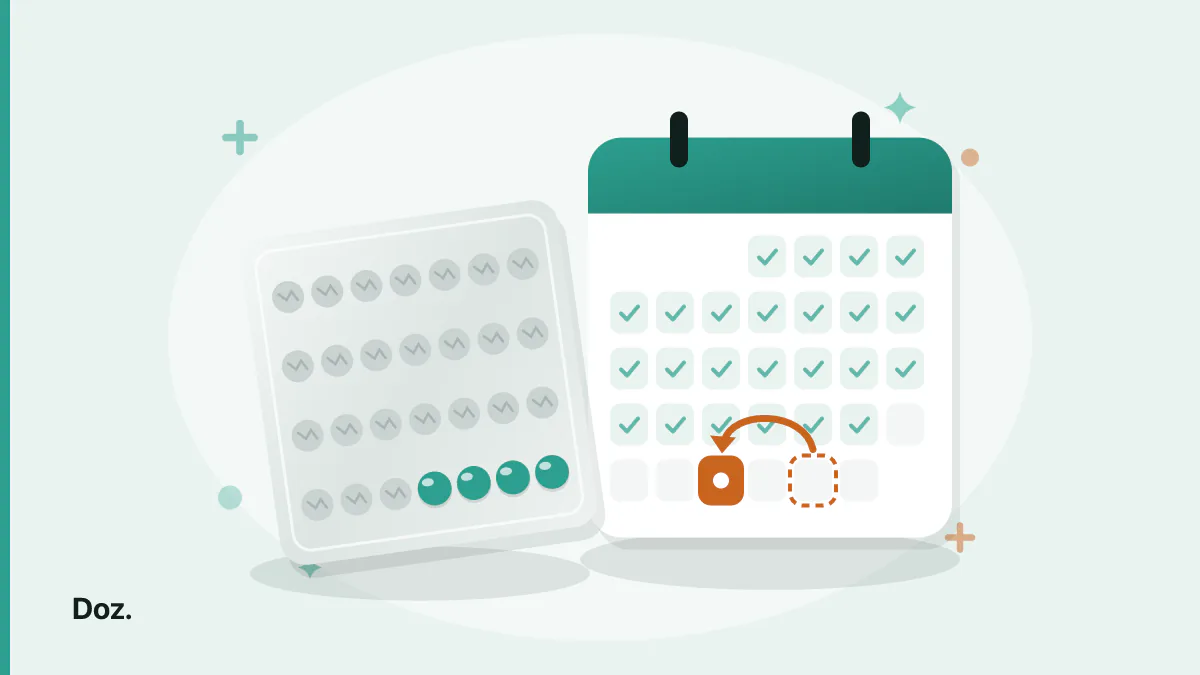
It is easy to read "once a month" as "the same day of the month", and for some medicines that is exactly right. For others it is shorthand for a fixed gap in days, and after a few months the two schedules are a week or more apart. Nothing on the bottle looks different, so it is worth checking which kind you have before you set a reminder for the 15th.
Three things "monthly" can mean
| What the label says | What stays fixed | What moves | Example from the official sources |
|---|---|---|---|
| Same date each month | The date, such as the 15th | The weekday, and the gap is 28 to 31 days | The once-monthly ibandronate tablet: "the same date each month" (MedlinePlus) |
| Every 4 weeks (28 days) | The weekday | The date, up to 3 days earlier each month | Mepolizumab (Nucala): "once every 4 weeks" (FDA label) |
| Monthly, scheduled from the last dose | The gap from the last dose | The date moves if a dose is late | Erenumab (Aimovig): after a missed dose, give it as soon as possible, then monthly "from the date of the last dose" (FDA label) |
Every 30 days is a fourth version some schedules use. It keeps neither the date nor the weekday: from 15 January, the next doses fall on 14 February, 16 March and 15 April.
These examples only show the difference between the schedules. For your own medicine, follow its leaflet.
Same date or every 4 weeks: one year side by side
Starting on Friday 15 January 2027, the three schedules drift apart like this:
| Dose | Same date each month | Every 4 weeks | Every 30 days |
|---|---|---|---|
| 1 | Fri 15 Jan 2027 | Fri 15 Jan 2027 | Fri 15 Jan 2027 |
| 2 | Mon 15 Feb | Fri 12 Feb | Sun 14 Feb |
| 3 | Mon 15 Mar | Fri 12 Mar | Tue 16 Mar |
| 4 | Thu 15 Apr | Fri 9 Apr | Thu 15 Apr |
| 5 | Sat 15 May | Fri 7 May | Sat 15 May |
| 6 | Tue 15 Jun | Fri 4 Jun | Mon 14 Jun |
| 7 | Thu 15 Jul | Fri 2 Jul | Wed 14 Jul |
| 12 | Wed 15 Dec | Fri 19 Nov | Sat 11 Dec |
| 13 | Sat 15 Jan 2028 | Fri 17 Dec | Mon 10 Jan 2028 |
By dose 13 the every-4-weeks schedule is a month ahead of the same-date one. It fits 13 doses into 2027, from 15 January to 17 December, and its 14th falls on 14 January 2028. The same-date schedule fits 12 into 2027. Every 30 days lands its 13th dose on 10 January 2028, five days before the first anniversary.
Watch the weekdays in the same-date column if you treat a same-date medicine as "the 15th". The 15th is a Friday in January, a Monday in February and a Saturday in May, so a dose you tie to a weekly routine, such as a Saturday morning, will not stay there.
Working out each date in your head is where mistakes creep in, so it helps to have them worked out once. Doz is a free download on the App Store: for a medicine taken every 4 weeks or every 30 days, you can set it to repeat every 28 or 30 days and Doz reminds you on each dose day, at the time you choose. It counts days, though, and has no "same date each month" setting, so for a medicine that has to fall on the 15th, a monthly repeating event in your iPhone's Calendar app does that job better.
When the date falls on the 29th, 30th or 31st
A same-date schedule that starts on the 31st has nowhere to go in February, April, June, September or November, and one that starts on the 29th or 30th hits the same problem in February. If your label doesn't say what to do, ask your pharmacist when you start, so you know in advance which day to use in a short month.
What the labels say about a late or missed monthly dose
The rules differ between medicines, even when all of them are called monthly.
| Medicine | Schedule | If a dose is missed |
|---|---|---|
| Ibandronate, once-monthly tablet | Same date each month | If the next scheduled dose is more than 7 days away, take it the morning after you remember, then go back to your usual date. If it is 7 days away or less, skip it. Never take two within a week (MedlinePlus) |
| Erenumab (Aimovig), galcanezumab (Emgality) | Monthly | Take it as soon as you remember, then count the next month from that dose, so your date moves (MedlinePlus) |
| Mepolizumab (Nucala) | Every 4 weeks | Take it as soon as you remember, then carry on with the regular schedule (MedlinePlus) |
After a missed dose, ibandronate goes back to its usual date, while erenumab's date moves. If your leaflet doesn't spell out which applies to you, ask your pharmacist before you need the answer. For general rules on missed doses, see what to do if you miss a dose.
Depo-Provera is every 3 months, not monthly
The birth control injection's labels set a gap of about 3 months: 13 weeks for Depo-Provera CI, and 12 to 14 weeks for depo-subQ provera 104. The Depo shot calculator works out the next due date from your last injection.
Setting it up
- Find the exact words on the label or leaflet: "once a month", "every 4 weeks", "every 28 days", "on the same date each month".
- If it is a number of days or weeks, the medication cycle calculator lists the coming dates from your start date, and the printable dosing calendar puts them on paper.
- If it is the same date each month, write that date down, and check now what happens in short months if it is the 29th or later.
- Set the reminder to match, then check the next few dates against the label once.
A monthly prescription refill is a separate calendar from a monthly dose, and it drifts for its own reasons; 28-day vs 30-day prescriptions explains that one. If your schedule is every other day rather than monthly, see the every other day medication schedule.
Frequently Asked Questions
Does monthly dosing mean the exact date or an exact number of days?
It depends on the medicine. Some labels mean the same date each month, such as the once-monthly ibandronate tablet. Others mean a fixed gap, such as every 4 weeks. Your leaflet says which, and your pharmacist can confirm it.
Is every 4 weeks the same as once a month?
No. Every 4 weeks is 28 days, so it keeps the same weekday and the date moves up to 3 days earlier each month. Most years that gives 13 doses, compared with 12 for the same date each month.
What if my monthly date is the 31st?
February, April, June, September and November have no 31st. If your label doesn't say which day to use instead, ask your pharmacist when you start, so you know the plan for short months.
Can Doz remind me once a month?
Doz can repeat a dose every 28 or 30 days, which fits a medicine taken every 4 weeks or every 30 days. It has no setting for the same calendar date each month, so for that a monthly repeating event in your iPhone's Calendar app works better.
Sources
- MedlinePlus: Ibandronate
- MedlinePlus: Erenumab-aooe injection
- MedlinePlus: Galcanezumab-gnlm injection
- DailyMed: Aimovig (erenumab-aooe) prescribing information
- MedlinePlus: Mepolizumab injection
- DailyMed: Nucala (mepolizumab) prescribing information
- DailyMed: Depo-Provera CI prescribing information
- DailyMed: depo-subQ provera 104 prescribing information
Download Doz on the App Store · Read the FAQ · More from the blog