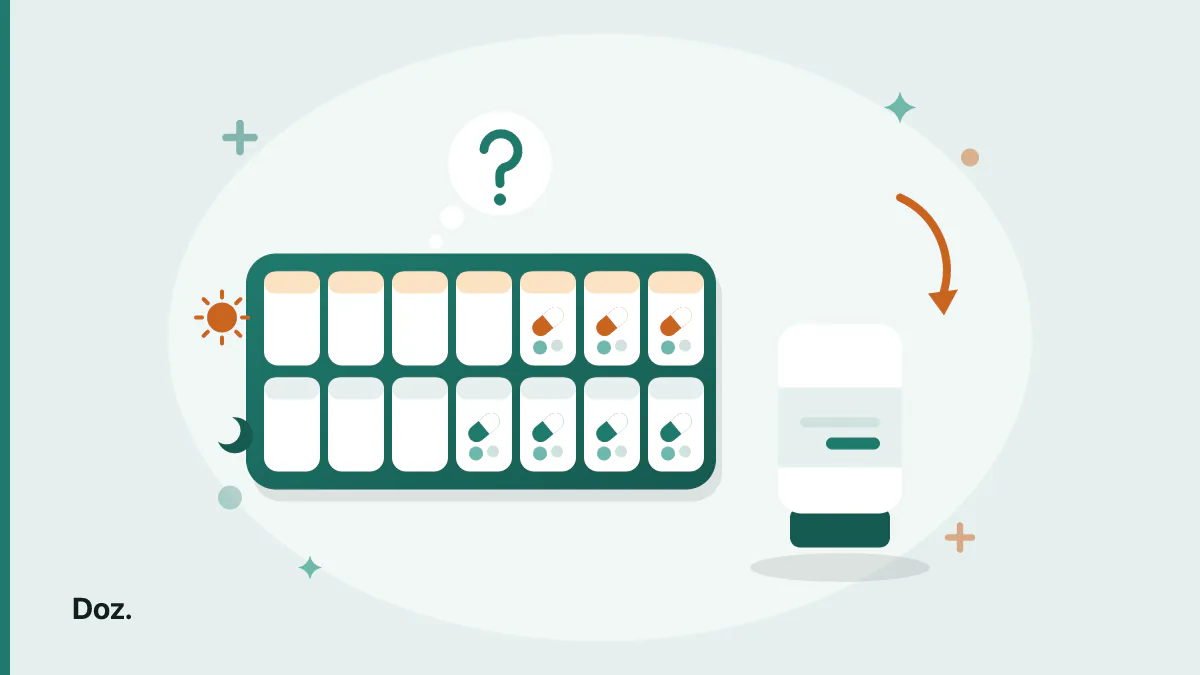
If you've ever stood in your kitchen thinking "did I already take that?" — the organizer isn't helping you the way you think it is.
It's not that weekly pill organizers are bad. It's that they answer a question you weren't asking.
Why the weekly organizer fails
A 7-day pill organizer answers exactly one question: did I take anything on Wednesday?
But that's not the question you actually have. Yours is: did I take the morning one, or was that yesterday?
One compartment per day cannot answer that. If you take something twice a day, the box is half-open by 8am and stays half-open until bedtime — so an open compartment means "mid-day" rather than "taken" or "not taken", and by the evening you've lost track of which half it represents.
The AM/PM boxes are meant to solve this, and they half-do, at the cost of compartments too small to open without a fingernail. There's a better way to split the week.
Fix 1: Split by time, not by day
Use two organizers. One for mornings, one for evenings.
Then — and this is the part that does the work — put them in different rooms. Morning box by the kettle. Evening box by your toothbrush.
Now the question answers itself. You're never standing in front of a box wondering which half of the day it represents, because the box is attached to a moment rather than a date. Two cheap boxes beat one expensive one with tiny dual compartments.
Fix 2: The bottle flip
For anything still in its original bottle: turn the bottle upside down after you take it.
Right side up means not taken yet. Upside down means done. Flip them all back when you refill, or at the start of the week.
Costs nothing, takes no time, and works from across the room — you can check from the doorway without touching anything. This is the single best trick for the "did I already?" problem, and it scales: five bottles on a shelf, all upside down, means the whole morning is finished.
Fix 3: Fill it somewhere you can't rush
Most people fill the organizer standing at a counter in a hurry, which is exactly how you end up with a Thursday that's missing something.
Do it sitting down, with the TV on, attached to something you already do weekly — laundry, the grocery order, whatever your Sunday actually contains. Nobody remembers to do it on Sunday because it's Sunday. It works because it rides along with something else you already never forget.
Fix 4: Check tomorrow, not today
Glance at tomorrow's compartment tonight.
If it's empty when it shouldn't be, you find out with a day to fix it — instead of at 7am with no options and a pharmacy that opens at nine. This is a five-second habit that converts emergencies into errands.
If you'd rather fill the box against a page than against your memory, the pill organizer planner prints a 7-day grid from your medication list.
The one thing an organizer can't do
None of this replaces a record.
An organizer tells you about this week and nothing else. Empty a compartment and the information is gone. So if you're ever asked "how consistent have you been?" — by a doctor, at a review appointment, or by yourself when something isn't working — an empty compartment from three weeks ago cannot help you.
That's what a log is for, on paper or in an app. For a short course specifically, a printable dosing calendar does the job better than a box — every day dated, a tick box per dose, and the finish line visible. The two tools do different jobs: the organizer handles today, the log handles the history. Neither replaces the other.
Where an app fits
If you keep a log on your phone, Doz does the history part: a Today screen for what's due, and a record of what you actually marked as taken, so the "how has it been going" question has an answer. It also handles the twice-a-day case properly, because each dose is its own item rather than a day-shaped compartment.
If you're managing several medications at once, that has its own set of problems — mostly around collisions and interactions rather than memory.
But for the daily "did I already take it" panic, the upside-down bottle beats everything, and it costs nothing. Start there.
Download Doz on the App Store · Read the FAQ · More from the blog