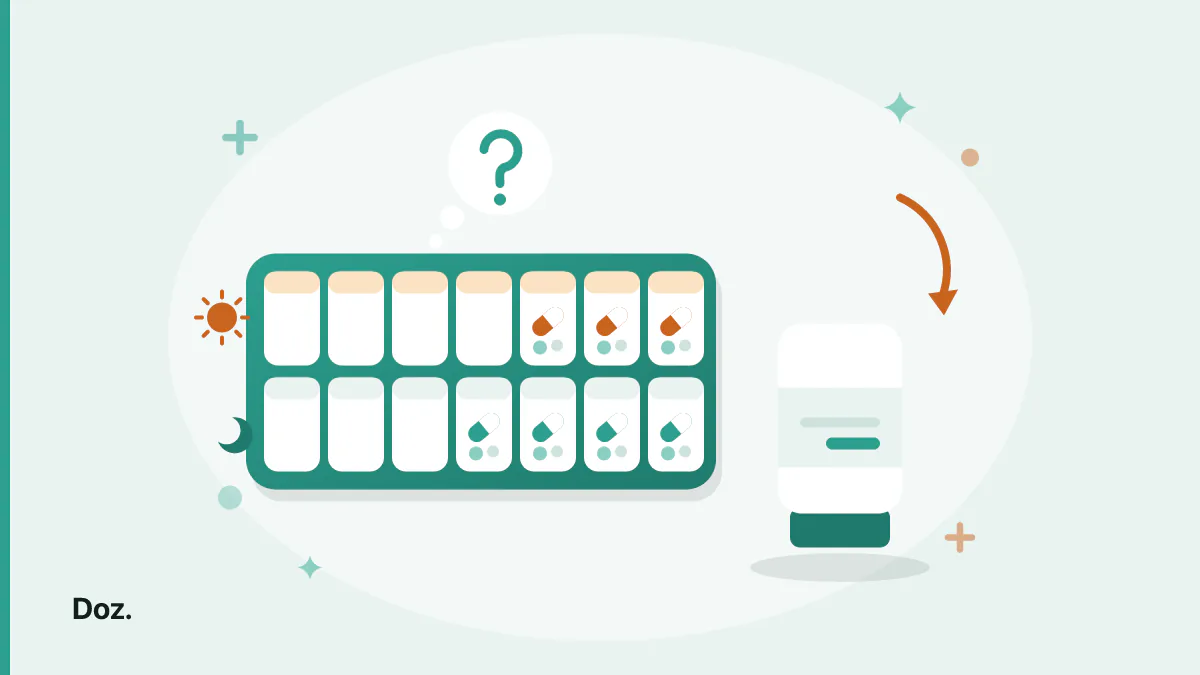
You can picture yourself at the counter with the glass of water. You just can't tell whether that was this morning or yesterday. If you're unsure whether you took a dose, don't take another one to be safe. Check for evidence first, and if there isn't any, ask a pharmacist before you take anything.
What to do right now
Work through these in order. Stop at the first one that gives you an answer.
- Look for physical evidence. Is today's compartment of the pill organizer empty? Is there a gap in the blister strip where today's pill should be? If the strip has the days printed on it, the answer is right there.
- Count, if you know the starting number. If the bottle had 30 on the 1st and today is the 10th, a once-a-day medicine should have 20 left if you've taken today's and 21 if you haven't. This only works if you know the count and haven't missed or doubled anything else this month. The pill count checker does the arithmetic.
- Check your log, if you keep one. A tick on paper or a dose marked as taken in an app, with a time on it, settles it.
- Still not sure? Read the leaflet, or call a pharmacist. The leaflet's missed-dose section says what to do for your medicine, and a pharmacist can tell you over the phone whether taking it now is safe. Have the medicine's name and strength in front of you.
Whatever you do, don't take a second dose just in case. The NHS Specialist Pharmacy Service and MedlinePlus both tell people not to take a double dose to make up for a missed one, and an unknown dose is the same gamble. Whether a late dose or a skipped one is safer depends on the medicine, which is why the question goes to a pharmacist and not to a guess.
If you think you took it twice
If you've already taken it again and now believe it was a second dose:
- In the US, call Poison Help on 1-800-222-1222. It is free and open 24 hours, and a dose taken twice by mistake is the kind of question it answers.
- In the UK, call NHS 111, or ask a pharmacist.
- Elsewhere, call your local poison centre or a pharmacist.
- If the person has collapsed, is having a seizure, or is struggling to breathe, call emergency services (911 in the US, 999 in the UK).
Some medicines matter more than others here. The missed-dose guidance from the NHS Specialist Pharmacy Service singles out medicines such as insulin, warfarin, antiseizure medicines and once-weekly methotrexate as needing their own advice, and a doubled dose of any of these is worth a call, even if you feel fine.
Stop having to guess
Once the moment has passed, memory can't settle the question, but a note made as you took the dose can. Doz is a free download on the App Store: when you log a dose, Doz shows it as "Taken at" with the time, and you can see when you last took a medication from a widget on your Home Screen or Lock Screen, or by asking Siri "When did I last take my metformin in Doz". It only knows what you log, though. If you swallow the pill and forget to tap, Doz will still show it as due, and it can't tell you whether a second dose is safe. That part stays with the pharmacist.
Why you can't remember
Taking a daily pill is the kind of action your brain stops recording. You do it at the same time, in the same place, with the same glass, every day, so today's memory looks almost exactly like yesterday's. When you try to recall it, you find a clear memory of taking the pill. You just can't tell which day it belongs to.
It gets worse in a few predictable situations:
- You were interrupted. The phone rang between opening the bottle and swallowing, and now you remember the bottle but not the pill.
- You thought about it. Planning to take it ("I'll do it after this email") leaves a memory that feels a lot like having done it.
- Your routine changed. Weekends, travel, a late night or a different breakfast take away the cues that normally carry the habit.
- You take several medicines. Five pills at three different times give you more chances to mix up which one you've already taken.
None of this is a sign of a memory problem. It happens to people with very good memories, because nothing about an ordinary dose makes it stand out. If memory is a wider worry, our guide to medication reminders for someone with memory problems covers that situation.
Ways to make "did I take it?" answerable
Each of these leaves some evidence behind. They differ in what that evidence proves and where it fails.
| Method | What it shows | Where it fails |
|---|---|---|
| Weekly pill organizer | Today's compartment is empty or full | One compartment a day can't tell morning from evening; mistakes when filling it go unnoticed |
| Calendar blister pack | Today's pill is out of its labelled pocket | Only if your pharmacy packs it this way; one strip per medicine |
| Turning the bottle upside down | Done for today, visible from across the room | Only for that day; you have to flip them all back |
| Paper chart with a tick | Ticked, and when you wrote it | Only if you tick it at the moment you take the dose |
| Reminder app with a dose log | Taken, with the time logged, and a history | Records the tap, not the swallow; the phone has to be with you |
| Counting the pills left | Whether the count matches the days so far | Needs a known start count; one earlier mistake throws it off |
Three habits make any of them work better:
- Log at the moment you take it, not later. A tick written an hour afterwards is itself a memory, and the same blur applies. Put the pen, the chart or the phone next to the pills, so the dose and the record happen together. If you use an app, an NFC sticker on the bottle lets you log by touching your phone to it as you open the cap. Our Apple Watch and NFC guide shows how to set that up.
- Pair the dose with a fixed action. Same place, same moment: by the kettle before the first coffee, or next to your toothbrush at night. The routine itself becomes a check. If the toothbrush is wet and the pill isn't logged, you know where you are in the evening.
- Make the evidence visible from where you'll wonder. People ask "did I take it?" away from the pills, at work or in bed. A Lock Screen widget or a chart on the fridge you pass anyway answers it without a trip to the cupboard.
For more on why the weekly organizer answers the wrong question and how to fix it, see the problem with 7-day pill organizers.
When it keeps happening
If you're unsure every few days, the method isn't working, and it's worth changing it rather than trying harder. Pick one from the table that leaves evidence where you'll look. If the medicine is one where a double dose is risky, tell your pharmacist that you sometimes lose track. They may suggest a calendar blister pack or a simpler schedule. For what to do when a dose really was missed, see what to do if you miss a dose, and for the wider picture, why people miss medication doses.
If you'd like the log to happen as you take each dose, Doz reminds you at each dose time and keeps every dose you mark as taken, with its time, so the answer is there the next time you wonder.
Frequently Asked Questions
What should I do if I can't remember whether I took my medication?
Don't take another dose to be safe. Check for evidence first: an empty organizer compartment, a gap in the blister strip, a pill count, or a logged dose. If you still can't tell, read the missed-dose section of the leaflet or call a pharmacist, and have the medicine's name and strength ready.
Is it better to skip a dose or risk taking it twice?
It depends on the medicine, so ask a pharmacist rather than guessing. The NHS Specialist Pharmacy Service and MedlinePlus both advise against taking a double dose to make up for a missed one.
What should I do if I accidentally took my medication twice?
In the US, call Poison Help on 1-800-222-1222, which is free and open 24 hours. In the UK, call NHS 111 or ask a pharmacist. If someone has collapsed, is having a seizure or is struggling to breathe, call emergency services.
How can I remember if I took my pills?
Leave evidence at the moment you take each dose: a pill organizer or blister pack you can see, a tick on a chart, or a dose logged in a reminder app with the time. Logging later doesn't help as much, because by then you're relying on memory again.
Sources
- NHS Specialist Pharmacy Service: Advising on missed or delayed doses of medicines
- MedlinePlus: Aspirin, "What should I do if I forget a dose?"
- HRSA: Poison Help line, 1-800-222-1222
- NHS: When to use NHS 111
Download Doz on the App Store · Read the FAQ · More from the blog